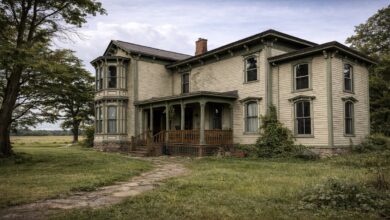
In the historic city of Vicksburg, standing along what was once a key route through the region, the McRaven House occupies a distinctive place in American architectural and cultural memory. Built in the late 18th century and expanded across multiple eras, the house reflects more than one moment in time. Its reputation today rests not on a single event, but on accumulation. War, illness, domestic life, and later interpretation all shaped how the house is perceived.
McRaven House is often introduced through dramatic framing, yet its significance is best understood through historical layering. Unlike abandoned structures frozen at one moment, this house evolved continuously. Each generation altered its function, added space, and left traces behind. The result is a residence where continuity itself became the defining feature.
Origins before national conflict
The earliest portion of McRaven House was constructed around 1797, when the region was still part of the expanding American frontier. The original structure was modest, reflecting the needs of settlement rather than status. Built from locally available materials, it prioritized shelter and durability.
At this stage, the house was a private domestic space. It served everyday needs tied to land use, travel, and family life. Its location along a travel route ensured interaction with the outside world, but the house itself remained firmly domestic. Similar human responses to silence and environment appear in Harrisville House.
This early simplicity formed the foundation for later expansion.
Architectural growth over time
Unlike houses completed in a single era, McRaven House expanded incrementally. Additions were made during the nineteenth century, each reflecting contemporary styles and needs. Federal era elements, later Victorian influences, and practical extensions coexist within the same structure.
These transitions are visible in ceiling heights, room proportions, and construction techniques. Rather than blending seamlessly, the changes remain legible.
The house functions as a physical timeline, where architecture records shifting priorities.
The Civil War and occupation
McRaven House is most closely associated with the American Civil War, particularly the siege of Vicksburg. During this period, the house was occupied by Confederate and later Union forces.
Its position made it useful as a headquarters, hospital space, and temporary lodging. Soldiers passed through rooms originally designed for family life. Medical treatment occurred where meals were once prepared.
This temporary transformation altered the emotional imprint of the space.
Illness, injury, and care
As with many buildings pressed into wartime service, McRaven House became associated with illness and death. Soldiers wounded in battle were treated within its walls. Limited medical knowledge and resources shaped outcomes.
These experiences were documented broadly across Vicksburg during the siege. The house was one of many structures adapted to emergency use.
Its association with care and loss was not unique, but it was personal.
Return to domestic life
After the war, McRaven House returned to private ownership. Families lived there again, adapting rooms back to domestic use. Daily routines resumed within spaces that had witnessed upheaval.
This return is significant. The house did not remain frozen as a wartime relic. It continued to function as a home.
Such continuity blurred boundaries between memory and present use.
Generational occupation and memory
Over decades, residents were aware of the house’s history. Stories circulated informally. Certain rooms carried associations passed down through retelling.
This type of memory transmission is common in historic homes. Meaning accumulates gradually, shaped by conversation rather than documentation.
The house became layered not only architecturally, but narratively.
Sensory qualities of an old structure
McRaven House, like many historic homes, exhibits sensory irregularities. Floors shift. Wood expands and contracts. Sound travels unevenly between rooms.
Lighting varies due to window placement and wall thickness. Temperature differs between older and newer sections.
These characteristics influence perception, especially in quiet conditions.
Interpretation and later reputation
In the twentieth century, McRaven House began to attract attention beyond private circles. Its Civil War associations and age made it a point of interest for visitors.
Interpretive narratives expanded to include accounts of sensed presence and unusual experiences. These accounts were shaped by existing knowledge of the house’s layered past.
Once a framework exists, experience tends to align with expectation.
The role of guided narrative
As McRaven House entered public awareness, storytelling became structured. Tours emphasized chronology, architectural change, and historical events.
Interpretive framing inevitably influences perception. Visitors are primed to notice details that align with narrative emphasis.
The house became a place of guided memory rather than spontaneous discovery.
Distinguishing record from response
The documented history of McRaven House includes construction phases, wartime use, and long term habitation. These facts are well established.
Personal responses to the space vary. Feelings of presence, reflection, or unease are subjective and influenced by context.
Understanding the house requires respecting both without conflating them.
Why layered houses feel different
Buildings with continuous occupation across major historical events often feel different to visitors. They compress time. Multiple eras coexist within one structure.
This compression can feel emotionally dense. The mind registers contrast between peaceful domestic rooms and their former uses.
McRaven House exemplifies this effect.
War without ruin
Unlike many Civil War sites reduced to ruins, McRaven House survived intact. Its survival allows direct engagement with scale and proportion.
Visitors can stand where events occurred without abstraction. This proximity intensifies response.
The house carries history without needing reconstruction.
Memory anchored in use
Because the house returned to everyday life after the war, memory did not remain isolated. It blended with routine.
This blending makes historical association feel closer and less ceremonial.
McRaven House was not preserved immediately as a monument. It lived on.
Cultural framing of historic homes
In American culture, historic homes often serve as anchors for local identity. Stories attached to them reinforce continuity with the past.
McRaven House fulfills this role in Vicksburg. It represents settlement, war, recovery, and persistence.
Its reputation reflects that breadth.
Why McRaven House endures
The house endures because it offers more than a single story. It embodies transition. Frontier to town. Peace to war. War back to peace.
Each phase left traces without erasing the previous one.
This accumulation sustains interest.
Between history and interpretation
McRaven House does not require extraordinary explanation to feel significant. Its documented past provides sufficient weight.
Interpretation adds emotional texture, but the foundation remains historical.
The house invites reflection rather than belief.
A residence shaped by continuity
Ultimately, McRaven House is defined by continuity rather than disruption. Even war did not end its use. Even time did not erase its form.
Its rooms adapted, then adapted again.
That adaptability is its legacy.
A place where time overlaps
Walking through McRaven House today, one moves between centuries without leaving the building. Architectural shifts mark transitions more clearly than dates.
This overlap gives the house its character.
It feels layered because it is layered.
A quiet historical presence
McRaven House stands not as a ruin or spectacle, but as a structure that absorbed history and continued. Its reputation reflects how people respond to places where past and present coexist visibly.
In Mississippi, where history is deeply embedded in landscape, the house remains a point of connection rather than mystery. Related reflections on memory and perception can also be found in Bhangarh Fort.
It does not ask to be explained away. It asks to be understood in sequence.
Horizon Report documents places shaped by memory, infrastructure, and human decisions. Our editorial approach focuses on what remains physically visible, how abandonment unfolds over time, and how interpretation is clearly separated from observable evidence.
For readers seeking deeper context, the following background articles explore how ghost towns emerge, why communities are left behind, and why preservation matters in understanding collective history.
- Abandonment And Ghost Towns
- What Is A Ghost Town
- Why Towns Are Abandoned
- Preserving Abandoned Places
Editorial transparency matters. Observations are grounded in site layout, materials, remaining structures, and documented timelines where available. Interpretive layers are presented as interpretation, not assertion.
Careful readers often notice details worth refining. Thoughtful feedback helps ensure accuracy, clarity, and long term editorial integrity.